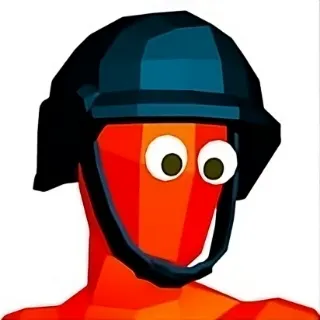
Play Time Shooter 3 Online — Free, No Download
About Time Shooter 3
The purple door is the tell. In Time Shooter 3: SWAT, hostage rooms sit sealed behind bright purple doors, and nothing on your keybinds opens one politely — you swing a battering ram into it or put a shotgun blast through the frame. What happens next is the whole game in a single image: the door gives way, and because the world only advances while you move, the room beyond hangs frozen in front of you. Orange gunmen caught mid-turn, blue hostages huddled between them, maybe a tracer already crawling toward the doorway you just made. You can stand on that threshold as long as you like, reading all of it. Then you take a step, time lurches forward, and the raid is on.
That color coding is your entire mission briefing. Enemies render orange, hostages render blue, and each level's clear condition is exact: every orange figure down, every blue one unharmed. The second clause is what separates this from ordinary room-clearing. The terrorists keep their captives close, so half the firing lanes in a hostage room pass within a stray round of somebody you are supposed to walk out alive. Fire discipline stops being flavor and becomes the core skill — confirming what color stands behind your target before you commit, choosing one accurate shot over a sprayed burst in a tight room, and remembering that a shotgun pattern wide enough to knock down a door is wide enough to clip a civilian standing near it. Bring your breaching weapon to the door and a precise one through it.
The opposition has raided a SWAT locker of its own. These enemies come equipped with riot shields, helmets, and body armor, and the game enforces the gear literally: an enemy dies to a direct hit on an exposed part of the body, so a round that lands on a vest, a helmet, or a raised shield is a round you wasted. Standing still turns every armored figure into a small aiming puzzle. Freeze the frame, study what the armor actually covers from where you stand, and either find an opening or reposition until one appears — a couple of sidesteps will often peel your angle around the edge of a riot shield that reads impenetrable from the front. Against a shield line holding a corridor, patience beats volume; the count on your gun is too low to spend proving that a riot shield stops bullets.
You can also take the fight to their equipment. A riot shield on the ground is yours if you want it — F picks it up, F throws it — and carrying one changes how a corridor full of leveled muzzles feels. Better still, the levels scatter explosive cylinders, and a single round into one does to a stacked group of armored enemies what your pistol never could, provided you check for blue first, because an explosion does not read color the way you do. The ram is not just a door key either: it breaks doors and wrecks objects alike, and the environments are studded with destructible pieces that make each raid feel physical rather than staged.
Every gun in your hands is a consumable. Weapons carry a fixed number of uses, printed at the bottom of the screen while you hold them, and there is no reload key — when the number reaches zero the weapon is scrap, fit only to be thrown at the next man while you take his. The roster runs from pistol to machine gun to shotgun, and each has a job: the pistol is a precision tool for exposed heads and hands, the machine gun answers the moments when several enemies commit at once, and the shotgun is both your hardest-hitting weapon and a breaching charge with a trigger. That double duty creates the game's quietest economy decision. Every shell spent on an enemy the pistol could have dropped is a shell you may want later at a purple door with no battering ram in sight, so the strongest gun in a level is often the one you carry the furthest and fire the least.
You are also harder to kill here than the series' reputation suggests. Three shield icons sit at the top of the screen; each hit you take removes one, and losing the third puts you down and restarts the level from the beginning. That margin is small, but it rewires the psychology of a raid. Pushing through a breached doorway becomes a survivable decision instead of a coin flip, which is exactly the aggression the SWAT premise asks of you — yet two mistakes in, the game snaps back into pure tension, because every frozen tracer in the room is now a level restart hanging in the air. The rhythm that wins is stop-start discipline: move in half-steps so incoming fire crawls, step out of a bullet's line rather than trading with the man who fired it, stop, re-read the room, and only spend your shields where the rescue genuinely demands it.
Time Shooter 3: SWAT is developer GoGoMan's third pass at the movement-drives-time formula, built in Unity and running straight in your browser with no download and no account. There is no fixed final mission — the scenarios keep coming, each one a self-contained raid short enough that a restart costs you a minute and a lesson rather than an evening. If the tactical side of bullet time is what hooks you, Time Shooter 1 and Time Shooter 2 are both here on Minix Games and show where the mechanics started, GoGoMan's Funny Shooter brings the same browser-native FPS craft in a very different mood, and the full /c/shooter library rounds out the genre from arena shooters to stealth puzzles. But this is the entry where the series found a job worth freezing time for: not just surviving the room, but bringing everyone in blue out of it.
Time Shooter 3 sits in our shooter games lineup. FPS, top-down and bullet-hell action.
How to play Time Shooter 3
- Load into a level and stay put at your spawn — while you stand still, time is nearly frozen, so use the pause to locate every orange enemy, every blue hostage, and any purple door before you take your first step.
- Move with WASD in short bursts. Time advances only while you move, so cross open ground in half-steps, stopping between them to re-check enemy aim and incoming fire.
- Left-click to pick up the nearest weapon and left-click to fire it. Note the number at the bottom of the screen — that is how many uses the gun has left, and there is no reloading.
- Aim for exposed body parts on armored enemies. Shots that hit helmets, vests, or riot shields are wasted, so sidestep to change your angle until you can see an opening.
- When you reach a bright purple door, breach it with the battering ram or a shotgun blast — those doors seal the hostage rooms and will not open any other way.
- Enter a breached room slowly: step, stop, and confirm which figures are blue before firing. Hostages must come through the level unharmed, so never fire a spread weapon into a crowded room.
- Press F to pick up a riot shield when an enemy drops one, and press F again to throw it. Use it to close distance on gunlines you cannot out-angle.
- Throw a dry weapon with right-click or R, then take a loaded gun off the floor — cycling weapons this way keeps you armed through an entire raid.
- Watch the three shield icons at the top of the screen. Each hit removes one and the third ends the run, so clear every enemy without harming a hostage to finish the level — a defeat restarts the current level from the beginning.
Controls
| W A S D | Move — time only advances while you are moving, so step in short bursts |
|---|
| Mouse + Left Click | Aim, shoot, and pick up weapons |
|---|
| Right Click / R | Throw your current weapon |
|---|
| F | Pick up or throw a riot shield |
|---|
Tips for Time Shooter 3
- Check the color behind your target before every trigger pull. Terrorists hold hostages close, and a level only clears if every blue figure survives — a safe shot in an empty room is a mission-ender in a hostage room.
- Budget your shotgun like a key, not a gun. Purple doors fall to a battering ram or heavy firepower, so if you have not seen a ram in the level, save shells for breaching and let the pistol handle exposed enemies.
- Solve riot shields with geometry, not ammo. Freeze in place, then take two or three sidesteps to peel your angle around the shield's edge — an exposed shoulder or leg dies to one accurate shot, while rounds into the shield itself just run your counter down.
- Shoot explosive cylinders when armored enemies stack near them — one round does the work of a full magazine. Scan for blue first; a blast near a hostage defeats the entire purpose of the raid.
- Grab a dropped riot shield with F before pushing a long corridor, and throw it with the same key once you are close — the shield covers the approach, and your gun finishes the job.
- Treat the uses counter as your planning number. Count how many shots each armored enemy actually costs you, and start moving toward the next dropped weapon before your current one hits zero, so you are never caught empty-handed mid-push.
- After breaching a door, step aside instead of standing in the frame. The doorway funnels every frozen tracer in the room toward one spot, and the opening you just made is the first place the room's guns are pointed.
- On your last shield icon, cut your movement in half. Smaller steps keep incoming fire crawling slowly, which restores the dodge windows you need — most failed raids end with a two-hit player sprinting when they should have been stepping.