
Slope: A Complete Guide to the Physics, the Speed Curve, and Beating Your High Score
Slope looks like a reflex test and is secretly a physics game. Here's how the ball actually moves, why you die where you die, the speed curve nobody explains, and the specific habits that push your score past 100.
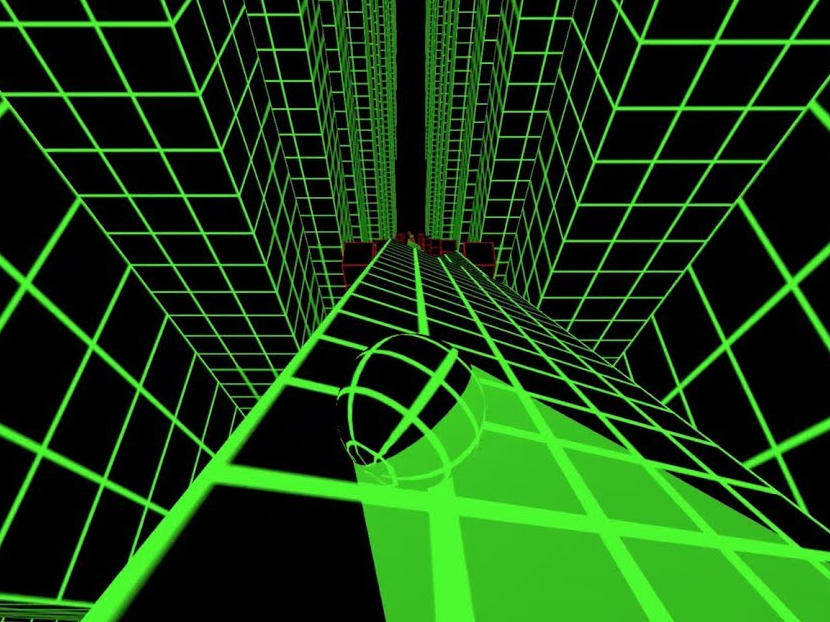
Slope is one of those games that everyone has played and almost nobody has actually studied. A neon ball rolls down an endless 3D course, you steer left and right, the speed creeps up, and eventually you clip an edge or eat a red block and start over. It reads as pure reflex. It isn't. Underneath the simplicity is a consistent physics model, a predictable speed curve, and a set of failure patterns that repeat every single run — which means the gap between a score of 20 and a score of 100 is mostly knowledge, not reaction time.
This is the guide we wish existed when our own scores were stuck in the double digits. We'll cover exactly what the controls do, how the ball's momentum really behaves, why the difficulty ramps the way it does, the specific ways you die, and the habits that fix each one. Keep a tab open and test as you read.
The controls (and the one thing the menu doesn't tell you)
You have two inputs: left and right, on the arrow keys or A and D. There is no brake, no jump, no boost. The ball is always accelerating down the slope; your only job is lateral positioning.
The thing the game never explains: your steering input controls sideways velocity, not sideways position. Tapping left doesn't move the ball one lane left — it gives the ball leftward momentum that keeps carrying it until you counter-steer. This is the single most important fact in the game. New players treat Slope like a grid where you nudge between lanes. Good players treat it like a marble on a tilting table, where every input has to be cancelled by an equal opposite input or you drift off the edge. Internalize that and half your deaths disappear.
How the ball really moves
The ball obeys a simplified but consistent physics model, and three properties matter:
- Forward speed only increases. There is no way to slow down. Distance survived equals speed accumulated, which is why late-game runs feel like a different game than the first ten seconds.
- Lateral momentum is sticky. Steering builds up sideways drift that persists. To hold a line you have to actively zero it out — a tiny tap the other way — not just release the key.
- Going airborne removes your control. When the course drops away and the ball launches off a ledge, your steering does almost nothing until you land. Every ramp and gap is a moment where you've temporarily lost the wheel, so you must aim before you go off the edge, not during the jump.
That last point is where most mid-tier runs end. Players keep steering in the air, land already drifting, and slide off. The fix is to commit your line just before a drop and then keep your hands still through the airtime.
The speed curve nobody explains
Slope's difficulty isn't random — it's a steady acceleration with no plateau. Roughly, the first 10–15 seconds are a tutorial pace where almost any input survives. From about 15 to 40 seconds the speed reaches the level where casual players cap out: fast enough that lazy steering drifts you off, slow enough that a careful player is comfortable. Past 40 seconds the course is moving quickly enough that you can no longer react to obstacles — you have to read ahead.
That's the real skill ceiling. At low speed you respond to what's in front of the ball. At high speed the ball reaches "in front of you" before your fingers can answer, so survival depends entirely on looking at the far end of the track and planning the line you'll need two seconds from now. Everyone who breaks 100 has made the same transition: they stopped watching the ball and started watching the horizon.
The five ways you die — and the fix for each
Almost every Slope death is one of these. Learn to name them and you'll start catching yourself.
- The over-steer slide-off. You tapped left to dodge, never cancelled it, and drifted off the left edge three seconds later. Fix: counter-tap to zero your drift after every dodge. Treat steering as paired inputs.
- The airborne wander. You kept steering through a jump, landed sideways, slid out. Fix: set your line before the ledge, hands still in the air.
- The tunnel-vision red block. You were watching the ball and a red obstacle appeared too late to avoid. Fix: eyes on the far end of the track, not the ball.
- The narrow-bridge panic. The course pinches to a thin path and you overcorrect into the void. Fix: on narrow sections, make smaller inputs, not bigger ones. Speed punishes big corrections.
- The speed wall. You simply hit a velocity where you couldn't process the track. That's not a mistake — that's your current ceiling. Fix: only reading-ahead raises it.
Concrete habits that raise your score
Beyond fixing deaths, a few proactive habits push the ceiling:
- Center by default. Unless an obstacle forces you, keep the ball in the middle third of the track. The center gives you room to react in both directions; hugging an edge gives you room in only one.
- Make the smallest input that works. The instinct under pressure is to slam the key. Small taps preserve the gentle drift you can still control; big inputs at speed are how you launch off the side.
- Use jumps to reset. Counterintuitively, a clean jump is a moment of calm — you can't steer anyway, so use the airtime to find the track ahead and pick your landing line.
- Play in fullscreen. More vertical screen means you see further down the track, which directly buys you reaction time. Press F11. It's worth a measurable chunk of score.
- Stop when you tilt. Slope rewards calm. The moment frustration speeds up your inputs, your runs get shorter. Walk away for two minutes and your average climbs.
When you've outgrown the original
Once you're consistently clearing the 40-second speed wall, the original Slope starts to feel slow, and that's the cue to move up. Slope 2 is the official sequel: the speed ramps faster, the obstacle layouts are tighter, and the read-ahead skill you built transfers directly — it just demands you do it sooner. Most long-term Slope players end up living there.
If you want the same micro-correction-at-speed muscle in a different shape, two games train it well. Tunnel Rush swaps the open slope for a rotating pipe of obstacles — same "read ahead, commit early" demand, different geometry. And Moto X3M is a stunt-bike time trial where momentum and exact landing timing are everything, which trains the same read-ahead reflex in a different shape. All three live on the broader no-download games shelf, no install required.
The short version
Slope is a momentum game wearing a reflex game's clothes. Steer in pairs so your drift always cancels out, keep your hands still through jumps, watch the far end of the track instead of the ball, and make the smallest correction that does the job. Do those four things and the speed wall moves from 40 seconds to well past a minute, which is most of the distance from a beginner score to a great one.
Go put it to work: open Slope, go fullscreen, and try to consciously name each death as it happens for one session. Naming them is how you stop repeating them. If you want neighbors in the same genre when you need a break, the car games shelf is where Slope lives alongside the rest of the high-speed picks.